
Stage Curtains Finishes
$ 1.03
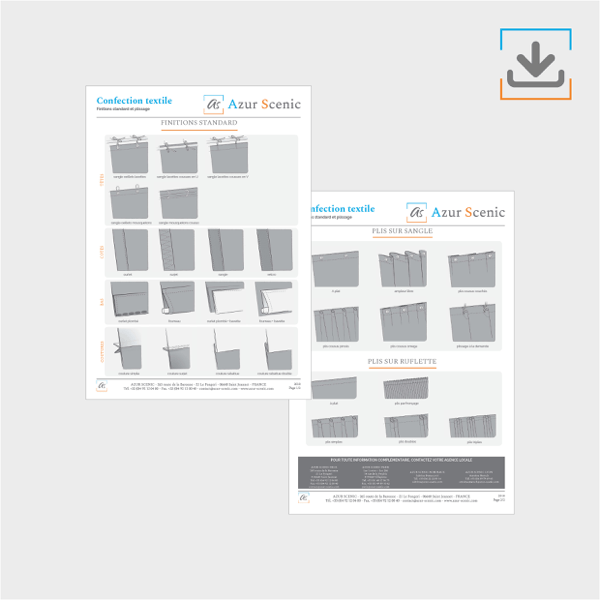
STAGE CURTAINS FINISHES BY AZUR SCENIC At Azur Scenic, we make all our stage curtains to order. Whatever you imagine, we can make it happen! To help you make your choice, we've listed the most popular stage curtains finishes. Of course, all the finishes suggested for the top of the curtain can also be applied to the sides and/or bottom. And vice versa!STAGE CURTAINS FINISHES : TOP FINISHESWe can, of course, produce countless finishes for curtain tops. Here we present the most popular finishes for the top part of our stage curtains:TAPE, EYELETS AND TIE TAPESA black, white or ecru flame-retardant tape, 40 or 80 mm wide, reinforces the top of the curtain. Metallic eyelets are attached to the tape at approximately 25 cm intervals. (The distance between the eyelets can be adjusted on request). 20 mm wide x 90 cm long ties are folded in half and inserted into the eyelets. This finish enables curtains to be hung under fixed or mobile poles, usually with a knot.For example, it is a very popular top finish for legs, scrims, canvases...It is, of course, possible to create a strap and eyelet finish without adding any ties. Our standard eyelets have an inner diameter of 17 mm. But we also offer eyelets with an inner diameter of 15 mm. Our collection also includes bigger eyelets, ideal for installing curtains directly on round rods.TAPE WITH TIES SEWN IN A "U" SHAPEA black, white or ecru flame-retardant tape, 40 or 80 mm wide, reinforces the head of the curtain. We sew flat ties every 25 cm or so, perpendicular to this tape. (These ties are ± 20 mm wide x 90 cm long. We can adjust the gap between ties on request). This finish makes it possible to hang stage curtains under a fixed or mobile pole using a knot. With this type of finish, the top of the curtain conceals the pole.For example, it is a very popular top finish for borders, for legs...TAPE WITH TIES SEWN IN A "V" SHAPEA black, white or ecru flame-retardant tape, 40 or 80 mm wide, reinforces the head of the curtain. We sew perpendicularly on this tape ties folded in 2 every 25 cm or so. (These ties are ± 20 mm wide x 90 cm long. We can adjust the gap between ties on request). This finish allows stage curtains to be hung from a pole. The difference with U-sewn laces is that in this configuration, the pole remains visible. In fact, the curtain is positioned just below the pole, not in front of it.This is a traditional finish that can be considered the "ancestor" of the "Tape, eyelets and tie tapes" finish. It is no longer in great demand. Indeed, if a tie tears, it's much easier to replace it with an eyelet than with a sewn one. So it's often preferred to finish with eyelets.TAPE, EYELETS AND HOOKSA black, white or ecru flame-retardant tape, 40 or 80 mm wide, reinforces the head of the curtain. Metallic eyelets are attached to the tape at approximately 25 cm intervals. (The distance between the eyelets can be adjusted on request). We then insert snap hooks into the eyelets. This type of finish is particularly useful for hanging curtains under a stage curtain track.For example, it is a very popular top finish for proscenium curtains, rear curtains...Our standard snap hooks are 50 or 60 mm high. For smaller curtains, we offer 40 mm hooks. Our mechanical hooks are much easier to install under a curtain track than traditional swivel hooks (the latter are no longer needed, now that stage track runners are swiveling).TAPE WITH SEWN HOOKSA black, white or ecru flame-retardant tape, 40 or 80 mm wide, reinforces the head of the curtain. We sew on this tape snap hooks every 25 cm or so. (The distance between the hooks can be adjusted on request). This type of finish is useful for hanging curtains under a stage curtain track. What's the difference with hook on eyelets? In this configuration, the head of the curtain rises a little higher, slightly masking the track. However, we don't recommend this option, as the curtain could interfere with the opening and closing of the track. It is therefore preferable to have a curtain positioned under the track and to add a border.This is a traditional finish that can be considered the "ancestor" of the "Tape, eyelets and hooks" finish. It is no longer in great demand. Indeed, if a hook breaks or comes loose, it's much easier to replace it with an eyelet than with a sewn one. So it's often preferred to finish with eyelets. STAGE CURTAINS FINISHES : SIDE FINISHESWe can, of course, produce a variety of finishes for the sides of the curtains! Here are the most popular finishes for the sides of our stage curtains: HEMA hem reinforces the sides of the curtain to ensure an even, aesthetic finish. By default, our side hems measure 3 cm. However, we can adjust this dimension according to the technical constraints imposed by the fabric or for aesthetic reasons.This is the most popular finish for all types of stage curtains.In the case of a proscenium curtain, the hem at the center crossing is often much wider. In this case, our workshops can hem half a strip of fabric, usually 50 to 70 cm. The side hem is traditionally closed at the top and bottom, but can be left open on request.OVERLOCKThe sides of the curtain are simply overlocked to prevent fraying. This technique is rarely used, but it can be useful for preserving the maximum width of the fabric.When the curtain is made in full lengths, it is sometimes possible simply to leave the selvedges visible. However, this depends on the quality of the fabric selvedges. Certain dyeing or flame-retardant techniques can damage the selvedges, making them unsuitable for this type of finish.REINFORCEMENT TAPEA black, white or ecru flame-retardant tape, 40 or 80 mm wide, reinforces the sides of the curtain.This may be appropriate if you want to stretch your curtains laterally with clips or staple them.You can choose this type of finish symmetrically, or only on one side.It is, of course, also possible to add eyelets to a lateral reinforcement tape.HOOK AND LOOP TAPEOur workshops sew a hook and loop tape onto the side hem.This finish is useful for joining several curtains together. It can also be used to fix curtains to panels or frames.Our hook & loop tapes are 25 or 50 mm wide. They are available in black and white. STAGE CURTAINS FINISHES : BOTTOM FINISHESNaturally, we can produce a wide range of finishes for the bottom part of the curtains! Here are the most popular finishes for the lower part of our stage curtains:CHAIN POCKETOur workshops create a hem inside which a lead chain is attached. The chain enables the drape to hang properly and allows the curtain to flow smoothly when opening and closing.We adjust the weight of the lead chain according to the size of the curtains and the weight of the fabric. Of course, we can also make bottom hems without lead chain.This finish is undeniably our most popular finish for all types of stage curtains: proscenium curtains, legs... It is also perfectly suited to pleated curtains.PIPE POCKETOur sewers create a hem that's open on both sides, allowing you to insert a weighted pole. With this technique, you're assured of a perfectly straight curtain.To insert a 50 mm diameter pole, we recommend a 12 cm pocket. For a 30 mm pole, a minimum 8 cm pocket is recommended.This finish is only suitable for curtains made flat (without fullness).It is particularly suitable for scrims, canvases, cycloramas, reflectors... But did you know that it's also very useful for holding borders flat?STRAPA strap is a strip of fabric slightly higher than the pocket. It allows the curtain to have a uniform appearance across the entire face to be seen by the public.We make it when it's necessary to hide the lower part of the curtain with an extra thickness (e.g. pole visible in transparency). A strap can also be requested when the curtain needs to be perfectly aligned with the floor, or even "drag" along the ground. A leaded hem or a pole-weighted sleeve in contact with the ground risks premature wear and tear. That's why most hems are positioned 1 or 2 cm from the ground. The strap hides the sometimes perceptible gap between the ground and the curtain. STAGE CURTAINS FINISHES : FULLNESSFor aesthetic reasons, our customers can choose between curtains with a taut appearance and pleated curtains with fullness. Interestingly, the more pleated the curtain, the greater its sound absorption properties. Here we present the various pleating techniques we can apply to all our stage curtains:FLATOur workshops produce a curtain perfectly adjusted to the width dimension requested. Once installed, the curtain will have the appearance of a straight panel, with no wavy effect.To accentuate this straight, taut effect, you can opt for a low finish with a pipe pocket. This allows you to insert a weighted pole at the bottom of the curtain to repeat the even tension applied at the head.We often make flat curtains as part of legs, borders, rear curtains, etc.SEWN PLEATSMany of our customers want stage curtains that look plush and opulent, with excellent acoustic absorption.Using the sewn pleat technique, we form the pleats from the top of the curtain in a regular pattern. We secure these pleats with a seam at the top of the curtain. The suppleness of the fabric then naturally creates beautiful, regular waves at the bottom of the curtain.We mainly use this pleating technique on thick fabrics such as stage velvets.Depending on the budget and the desired volume effect, we can adjust the percentage of fullness. A curtain with 100% fullness will be made from a panel twice the finished width (e.g.: for a frieze with a finished width of 10 m, we make a flat panel 20 m wide, which we reduce to 10 m using sewn-in pleats). A 50% full-width curtain is built from a panel 1.5 times the finished width (e.g. for a 10 m wide frieze, we make a 15 m wide flat panel, which we reduce to 10 m using sewn-in folds). The greater the height of the curtain, the higher the value of the pleating. Most of the stage curtains we make have a fullness of between 40% and 100%.It's the ideal finish for the front curtain, but also for the teaser (main valance). But we also make it for various types of stage curtain, such as legs, borders or rear curtains.The photo opposite shows sewn Z pleats. This is the most popular type of sewn pleat. For illustrations of other possible sewn pleats (omega pleats, pinched pleats), we invite you to download our brochure.ON-DEMAND PLEATINGThe result of on-demand pleating is quite similar to that of sewn pleats. For on-demand pleating, our sewers don't sew the pleats directly, but shape them by joining 2 eyelets in a single tie.As with sewn pleats, we can modulate the percentage of fullness to suit the desired effect. We adjust the spacing of the eyelets to achieve the desired look.This more modern technique is gradually replacing the traditional sewn pleat finish. It gives the curtain's owner greater freedom to modulate it to suit his or her needs.FREE FULLNESSWith this technique, the folds are not preformed. We simply make a panel wider than the desired finished width dimension.With this technique, we adjust the width of the curtain to suit the desired effect. However, we recommend a minimum width of 50%, or even 100%, for a harmonious effect.We offer this technique mainly for curtains made with larger eyelets installed directly on round rods.GATHERED PLEATSFor this technique, our workshops sew the curtain top onto a ruflette tape. We make the curtain flat, wider than the desired finished width. Then, at the end of the production process, we gather the head of the curtain with the specially designed ribbon.However, we reserve this technique for curtains made from lightweight fabrics, such as sheers. STAGE CURTAINS FINISHES : SEAMSNOur expert sewers and upholsterers know how to use the best seams for each type of project. However, here are a few examples of the assembly seams we use most frequently:SIMPLE SEAMThe most frequently used seam for our curtains! It's very strong and discreet on the front. On the back of the curtain, the fabric edges are visible.OVERLOCK2 strips of fabric are assembled using an overlock machine. We mainly use this technique for fine fabrics (sheers, etc.) and stretch fabrics (stretch, lycra, etc.). If it remains visible on the back of the work, it's still quite discreet. FOLDED SEAMThis more complex seam is used in a number of special cases, including :Joining floor mats (to avoid extra thickness that would compromise the flatness of the finished mat)Assembly of curtains visible from 2 sides (provided the fabric is aesthetically pleasing on both sides, which is not the case with velvet, for example).Single and double folded seams are available. The illustration opposite shows a double folded seam.